Senior Lecturer in Cardiovascular Science, The University of Bristol
Incorporating Work With Both - Bristol Heart Institute & University Of Bristol
Official Social Media Platform Links for the University Hospital Bristol & Weston NHS Foundation Trust
Official Social Media Platform Links for the University of Bristol
- Top 10 UK university and 54th in the world (QS Rankings 2025)
- Top 5 UK university for research (THE analysis of REF 2021)
- Top 5 most targeted university by top UK employers (High Fliers 2024)
An Introduction To Dr Stephen C Harmer
Dr Stephen Harmer:
Biography
Steve Harmer graduated with a first-class BSc (Hons) in Molecular Biology from the University of Reading. He then undertook a PhD in Molecular Endocrinology at the University of Reading in the laboratory of Professor Philip Lowry.
After his PhD training, Steve joined Professor Andrew Tinker’s group at University College London to pursue post- doctoral research investigating the disease mechanisms underlying inherited cardiac arrhythmias (abnormal heart rhythms).
In October 2011, he moved to the William Harvey Research Institute at Queen Mary University of London. During this period his work established that mutations in potassium ion channels, which cause the Long QT Syndrome, act in the majority of cases to cause defects in ion channel trafficking.
In January 2013, he was awarded an Intermediate Basic Science Research Fellowship from the British Heart Foundation. In April 2018, Steve joined the University of Bristol as a Lecturer in Cardiovascular Science in the School of Physiology, Pharmacology and Neuroscience and in April 2021 was promoted to Senior Lecturer. Steve teaches cardiovascular science-related topics to Veterinary, Medicine, Physiology, Pharmacology and Biomedical Science students.
He also leads an active externally funded research team that focuses on understanding the causes of arrhythmias and developing therapeutic approaches to prevent sudden death in patients with inherited heart conditions.
Dr Stephen C Harmer Working With Donate For Defib W-s-M Project
A welcome from Project Lead, Josh Bell in an official quote:
A Proud Milestone for Donate For Defib Weston-super-Mare: Clinical Experts Meeting – 19th June 2025
Thursday 19th June 2025 marked a truly inspiring milestone in the journey of the Donate For Defib Weston-super-Mare project. We proudly hosted our Clinical Experts Meeting — a day filled with collaboration, celebration, and heartfelt gratitude. 💬❤️
We were deeply honoured to welcome Brigadier Nigel Beacom QVRM, Deputy Lord Lieutenant of Somerset, as our Special Guest Visitor. His presence and support are a powerful reminder of how vital our mission is — not just for Weston-super-Mare, but for communities across Somerset.
This special event was a celebration of the dedicated Clinical Team Members and Experts who work tirelessly behind the scenes to save lives. We were thrilled to present certificates and awards 🏅 to these true champions of emergency care, recognising their outstanding contributions to defibrillator awareness and response.
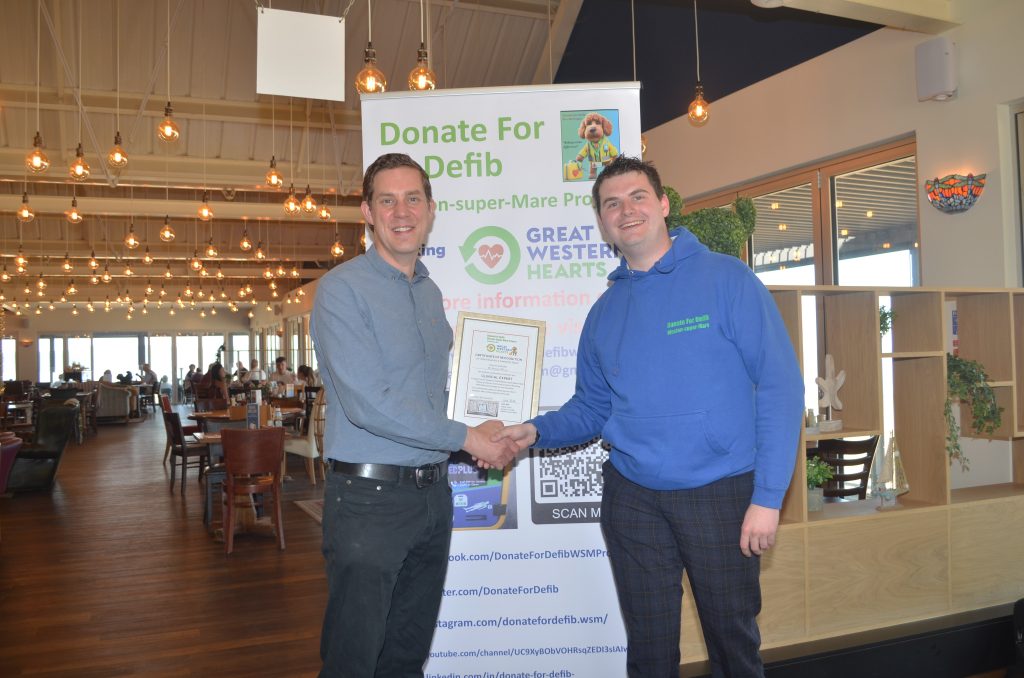
Certificate of Thanks Presented to Dr. Stephen C. Harmer – Clinical Expert Supporting Our Mission
We are proud to recognise Dr. Stephen C. Harmer, Senior Lecturer in Cardiovascular Science at the University of Bristol, for his outstanding support and ongoing contributions to the Donate For Defib Weston-super-Mare Project.
During a recent visit, Dr. Harmer was presented with a Certificate of Thanks by our Project Lead, Josh Bell, in recognition of his vital role as one of our Clinical Experts. His expert guidance has been instrumental in shaping our strategy and ensuring the safety, relevance, and impact of our community defibrillator programme.
With a deep passion for cardiac education and public health, Dr. Harmer continues to influence the development of effective defibrillator provision and awareness initiatives across Weston-super-Mare and beyond. His knowledge and insight help ensure our lifesaving mission is grounded in clinical excellence and the latest scientific understanding.
On behalf of our entire team, we thank Dr. Harmer for standing alongside us in our mission to save lives through accessible defibrillation and public education.
Dr Stephen Harmer - Speaking At The Donate For Defib Conference - 08.02.25
Presentation By: Dr Stephen C Harmer
Bristol Heart Festival
Donate For Defib W-s-M Project were truly delighted to be support the Bristol Heart Festival on Thursday, 13th March 2025!
To find out more about how the day went, read and click below!
Summary of Research Interests - Dr Stephen C Harmer
Sudden death due to cardiac causes (SCD) is a major clinical problem and the Long QT Syndrome (LQTS) is an important cause of SCD in young people. LQTS is characterised by a prolongation of the QT interval as visualised on an electrocardiogram (ECG). Thisprolongation can lead to the development of torsade-de-pointes, a characteristic irregular wave pattern on the ECG, and in turn ventricular fibrillation.
LQTS can be an inherited syndrome or acquired, usually as a result of drug therapy. Of the hereditary forms of LQTS approximately half of all cases are associated with mutations in KCNQ1 or KCNE1. These two proteins assemble to form a heteromultimeric channel complex, composed of a
tetramer of KCNQ1 α-subunits and between one and four KCNE1 β-subunits, which produces a potassium current in ventricular myocytes called I Ks .
The I Ks current is critical for repolarisation of the human cardiac action potential and mutations in either of these ion channel subunits can cause LQTS. In detail, mutations in KCNQ1 underlie LQTS type 1 (LQTS1) whilst mutations in KCNE1 account for LQTS5. Recently it has become clear that, in addition to their effects on channel function, mutations in either KCNQ1 or KCNE1 can act to disrupt the trafficking of the channel complex to its site of action at the cell surface.
Dr Steve Harmer’s research focusses on characterising the molecular mechanisms that underlie ion channel trafficking and why mutated channels become defectively trafficked.
His research interests include:
- Characterisation of the molecular mechanisms that underlie defective ion channel trafficking in the LQTS.
- Using inducible pluripotent stem cell (iPSc) technology to generate cardiac cells from patients with arrhythmic syndromes (including LQTS) that can be used as model systems in which to study disease mechanisms.
- The development of therapeutic strategies that can rescue the function of disease causing LQTS1 mutations with the aim of preventing sudden death in these patients.
Available Resources
University of Bristol -
Official Address:
The University of Bristol,
Faculty of Health & Life Sciences, School of Physiology, Pharmacology and Neuroscience,
Biomedical Sciences Building, Office DW2B,
University Walk,
Bristol, BS8 1TD.
Enquiries & Contacting Dr Stephen C Harmer
To contact Dr Stephen Harmer with any questions or information, please email: [email protected]
Also, feel free to complete our ‘Contact Us’ Form below that will be directly sent to Dr Stephen Harmer
Press - Good News Post Stories
Headline: "Saving Lives Together: Leading Heart Researcher Joins Weston Defib Campaign"
Good News Post Story
Date Published: 6th June 2025
Click the link below to view the whole article!